
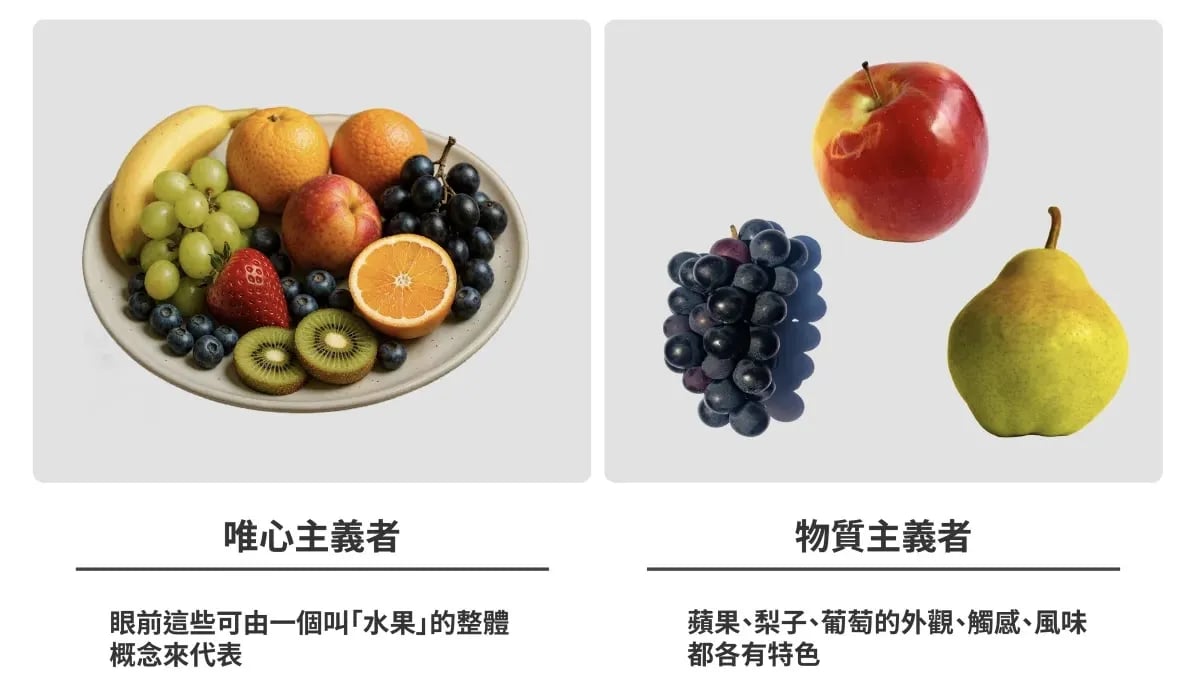
Idealism (literally “mind-only-ism”) is the position that mind, consciousness, or ideas are fundamental, and that matter is either a construction of minds or an expression of a mind-like principle.
- 主觀唯心論 (Subjective idealism) — George Berkeley: 存在即被感知 (esse est percipi). Objects have no existence apart from a perceiving mind; the world stays stable and shared only because it is continuously perceived by God.
- 客觀唯心論 (Objective idealism) — Plato’s 理型 (Forms), Hegel’s 絕對精神 (Absolute Spirit / Geist), 朱熹的「理」: the order of the world is itself a kind of Idea, independent of any individual mind.
- 先驗唯心論 (Transcendental idealism) — Kant: we can never know 物自身 (the thing-in-itself, Ding an sich); experience is always already shaped by the mind’s own forms — space, time, causality. In effect: 我們看到的不是世界本身,而是世界配上我們的認知介面。See The Map Is Not the Territory.
- 唯識 (Yogācāra, “consciousness-only”) — 萬法唯識: experience is the ripening of 種子 (karmic seeds) stored in 阿賴耶識 (ālaya-vijñāna, the storehouse consciousness).
- 泛心論 (Panpsychism) — the modern cousin: consciousness is a basic feature of matter everywhere, like mass or charge; complex minds are combinations of simpler ones.
Materialism / Physicalism is the position that matter and energy (物質) are fundamental, and that mind, consciousness and ideas are products of physical processes rather than their source.
- 唯心主義 ≠ 理想主義 The Chinese 唯心 sounds like 理想, but it is not “having ideals” or 「想太多」 — it is a claim about what reality is made of.
- 唯物主義 ≠ 物慾主義/拜金 Materialism as metaphysics is not 「愛錢」 or 「只在乎物質享受」 — that is consumerism. Marx’s materialism is in fact one of the sharpest critiques of money-worship.
- 唯心主義 ≠ 否認物質世界存在 Most idealists do not deny that chairs are solid; they argue that the chair’s solidity is mind-dependent, not mind-independent.
- 唯物主義 ≠ 否認意識存在 Only the eliminativist fringe dismisses experience itself; most physicalists take consciousness to be real — just not fundamental.
