
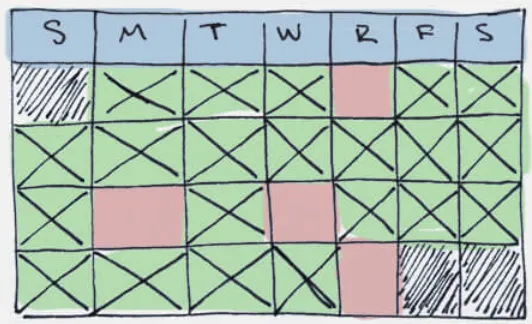

Missing one opportunity to perform the behavior did not materially affect the habit formation process.
Skipping one day won’t hurt your habit building/formation process, as long as you don’t skip the next one.
Missing two days in a row is the start of a bad habit; Never do it.
- 允許自己在養成習慣的過程中偶爾停下來休息,但不能超過 2 天。
- 這是一種自我緩衝的方法,可以讓身體保持在養成習慣的節奏,但也不至於長期處在神經緊繃的狀態中。
那些錯過好習慣的日子所造成的傷害,比成功執行好習慣的日子帶來的助益更大(Lost days hurt you more than successful days help you)
例如:從一百元開始存,百分之五十的獲利可以讓你擁有一百五十元,但只要再遇到百分之三十三的虧損,就會讓財產跌回到一百元。換句話說,避免百分之三十的損失,其價值等同於百分之五十的獲利。
The Goal-Gradient Effect
Don’t break the chain of continuity; Just keep showing up.
❝ CITATIONS
Hull, C. L. 1932. “The Goal-Gradient Hypothesis and Maze Learning.” Psychological Review 39 (1): 25–43. https://doi.org/10.1037/h0072640. ↩
Lally, Phillippa, Cornelia H. M. Van Jaarsveld, Henry W. W. Potts, and Jane Wardle. 2010. “How Are Habits Formed: Modelling Habit Formation in the Real World.” European Journal of Social Psychology 40 (6): 998–1009. https://doi.org/10.1002/ejsp.674. ↩
