
“Either write something worth reading or do something worth writing.” — Benjamin Franklin
”The skill of writing is to create a context in which other people can think. — Edwin Schlossberg
“Great writers comfort the confused and confuse the comforted” — David Perell
“Writing is a socially acceptable form of schizophrenia.” — E.L. Doctorow
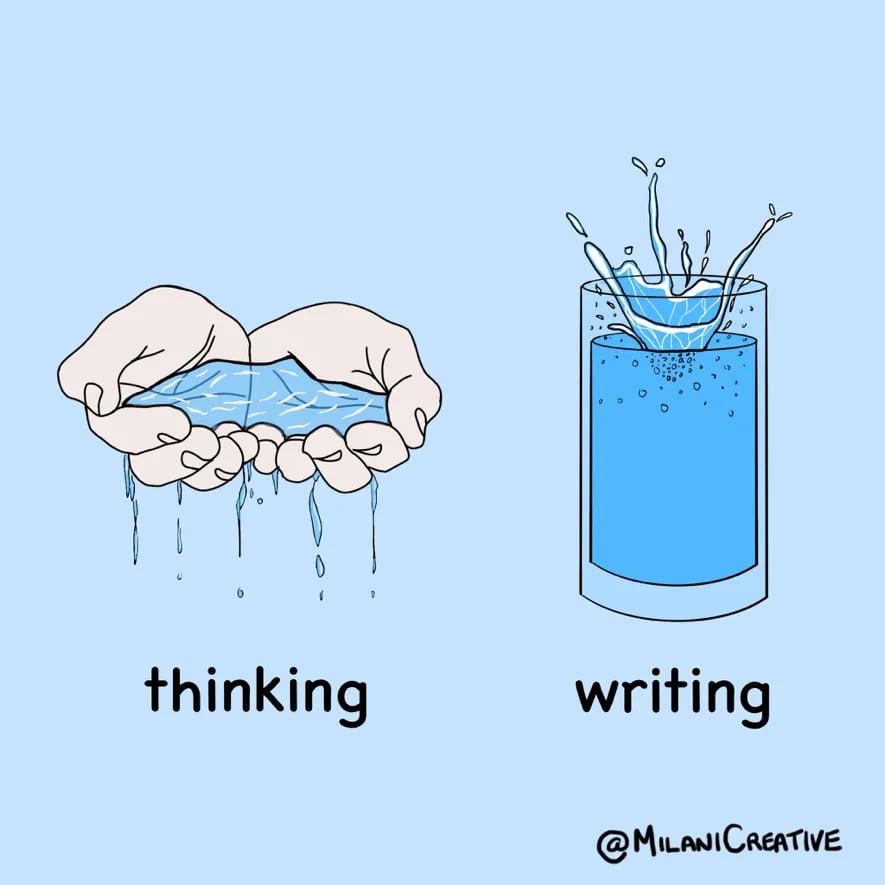
“The difficulty of writing is to transform a tangled network of thoughts into a linear string of words.” — Steven Pinker
寫作之難,在於將網狀的思考,梳理成樹狀的結構,並展現於線性展開的語句之中。
“If you’re thinking without writing, you only think you’re thinking.” — Leslie Lamport
“Once we begin to explore this much wider and deeper world, we realize how much we’ve been missing. It’s as though we’ve been living and working in a corridor without even realizing there are windows and doors on either side. More than that: writing enables us to open the window blinds, undo the catches, lean out and look, smell, hear, touch, taste adventure. We can climb out of those windows. Writing can give us the keys to open those doors: explore what’s on the other side.” — Alison Jones, Exploratory Writing: Everyday magic for life and work
“Writing isn’t about making money, getting famous, getting dates, getting laid, or making friends. In the end, it’s about enriching the lives of those who will read your work, and enriching your own life, as well. It’s about getting up, getting well, and getting over. Getting happy, okay? Getting happy.” — Stephen King, On Writing: A Memoir of the Craft
“You must write every single day of your life. You must lurk in libraries and climb the stacks like ladders to sniff books like perfumes and wear books like hats upon your crazy heads. May you be in love every day for the next 20,000 days. And out of that love, remake a world.” — Ray Bradbury
- I write to think better. Ideas don’t come out fully formed. They only become clear as we work on them.
- I write for interconnected thinking. Standalone concepts are harder to retain in our memory. Writing helps us link new ideas to those we already know, improving memory retention.
- I write to deliver value. My writing should be useful and impact people’s lives positively. It should inspire people’s action and change their perspectives.
- I write about things I intrinsically care about, not what’s popular. I prioritize writing things I’m intrinsically passionate about with long-term value. My writing should be authentic and opinionated. I don’t chasing news or trends solely for broader audience reach.
- I write to catalyze meaningful connections with interesting people. Public writing puts me in the arena, enabling people to see my work and give me feedback.
- 海明威 (Hemingway):用「簡單的字句、真實的情感」來寫作
- 我只是代替讀者把他們心中想說的話寫出來。
- If you get stuck while writing, pretend you’re writing to a specific friend or family member.
- If you’re teaching people how to succeed in a given field (or talking about your own success), start with how you failed. Few people reach the top, but everyone has failed—including those who eventually succeed.
- First, you should be changing your mind a lot as you write. If not, you probably aren’t doing enough research. Second, your first draft’s conclusion should be much tighter and more expressive than its introduction. If not, you probably haven’t learned anything from the writing process, which means the draft can be scrapped.
-
量變產生質變(Quality is a byproduct of quantity):Write something (but not necessarily published) every single day, preferably first thing in the morning. Writing stamina is built just like muscle. The writing muscle is the ability to sit down with your butt in the chair and your hands on the keyboard.
It’s not the writing part that’s hard. What’s hard is sitting down to write.
“The art of writing is the art of applying the seat of the pants to the seat of the chair. (「寫作的藝術,就是把屁股放在椅子上的藝術。」—詩人 羅伯特・佛羅斯特)” — Robert Frost
“Print out a giant calendar and make a big red X every day you’ve done writing and publishing.” — Jerry Seinfeld
“You don’t have to write, but you can’t do anything else other than writing during this one focus session. Either write or do nothing at all.” — Raymond Chandler
“Having a live tracking word count that looks like a progress bar which sits publicly on your personal website that everyone can see each day.” — Brandon Sanderson
“I write when I’m inspired, so I see to it I’m inspired every morning at nine o’clock.” — Peter De Vries
“Someone once asked Somerset Maughham if he wrote on a schedule or only when struck by inspiration. “I write only when inspiration strikes,” he replied. “Fortunately it strikes every morning at nine o’clock sharp.”” — Steven Pressfield, The War of Art
-
Writing is just putting words on a page. All it takes is to sit down and write one sentence, and then another, and then another.
-
The best writers don’t find time to write. They make time to write.
-
Paul Millerd’s approach to consistency with his newsletter: “Write most days, publish most weeks.”
-
Daily Performance Metrics
- Number of new evergreen notes
-
You have started writing while taking notes. Evergreen note-writing is the fundamental unit of knowledge work.
“If you want to write faster, the first step is to know what you’re writing before you write it.” — Rachel Aaron, 2,000 to 10,000: How to Write Faster, Write Better, and Write More of What You Love
“One of the earliest lessons I learned about writing was that if I was stuck, it was because I didn’t know something.” — Rachel Aaron, 2,000 to 10,000: How to Write Faster, Write Better, and Write More of What You Love
-
寫作,是從一則筆記開始的
- 最好的想法和洞見,往往是不期而遇的。最有趣的題目,通常是不曾事先計劃的。
- 讓興趣帶著你走就對了!(Follow your genuine intellectual curiosity 好奇心/求知慾 and interests)
-
- Number of new evergreen notes
-
Luhmann 很少強迫自己寫他不想寫的東西,他只寫那些「來得很容易」的靈感和想法,他在某次的訪談說道:「當我卡在某個地方 (寫作時),我就離開去寫別的。」
- Words per hour
-
Aim for a minimum baseline of:
- 1–2 articles/essays/blog posts per week
- 1000 creative hours per year
-
-
Turn your flow into stock. Build your content engine.
- Maintain your flow while working on your stock in the background
- Timing: when you find/notice themes/trends/patterns emerging in your daily shares on social media sites
- Stock and flow / Snarkmarket
- Flow is the feed. It’s the posts and the tweets. It’s the stream of daily and sub-daily updates that reminds people you exist.
- Stock is the durable stuff. It’s the content you produce that’s as interesting in two months (or two years) as it is today. It’s what people discover via search. It’s what spreads slowly but surely, building fans over time. 1
-
Stop/end each daily writing session in the midst of a sentence, paragraph, or chapter—right where you know exactly what comes next, even if inspiration is flowing. By creating your own “cliffhanger,” you prime your mind with a clear starting point for the next session. This leverages the Zeigarnik Effect, making it easier to resume, preserving momentum and enthusiasm, and ensuring each return feels fresh and inviting.
“You always stop when you know what is going to happen next, you go on from there. You write until you come to a place where you still have your juice and know what will happen next and you stop and try to live through until the next day when you hit it again. It is the wait until that next day that is hard to get through.” — Ernest Hemingway
-
Always make an outline. Always prep the page.
I never sit down and just “start writing.”
Instead, I Prep The Page with:
- A working title
- Section headers
- Sub-section headers
Then, once I have everything laid out, I’ll start brain-dumping notes inside each section/container.
And I won’t “start writing” until I have 90% of the chess pieces out in front of me, on the page.
“Every writing session after this realization, I dedicated five minutes (sometimes more, never less) and wrote out a quick description of what I was going to write that day. Sometimes it wasn’t even a paragraph, just a list of this happens, then that, then that. This one simple change—those five stupid minutes—boosted my word count more than any other single thing I’ve ever done. I went from writing 2k a day to 5k a day within a week without increasing my 6-hour writing block. Some days, I even finished early.” — Rachel Aaron, 2,000 to 10,000: How to Write Faster, Write Better, and Write More of What You Love
You have to know the general direction of your writing, and let it flow.
My outlines aren’t very detailed. It’s usually a set of bullet points that are maybe one or two sentences. But this is enough to keep me going to the next point.
And before you ask, yes. You can be more detailed if you want. That will actually make it easier.
The key here is to have the outline available, and to read it before you start each writing sprint so you know what you need to do as you go.
-
How to decide what is worth writing about?
- “Do I think this would be interesting/useful to at least 1 person in the world?” 2
- “What would I wish I know a week/month/year ago?”
-
Write to your former/younger self, i.e., Past You
“I write this not for the many, but for you; each of us is enough of an audience for the other.” — Epicurus
-
The 2-Year Test: write for yourself “2 years ago.”
- What questions did you used to have, that you now have answers to?
- What obstacles were you faced with, that you’ve since overcome?
- What outcomes did you desire, that you’ve since achieved?
- What skills did you want, that you now have?
Your audience isn’t some random person “out there.” Your audience is YOU, 2 years ago.
-
-
My writing should be opinionated, not hedged. I should prioritize my opinion over summarizing others. For second-hand information, I should add value by connecting ideas or sharing my thoughts. 3
“Writing is an act of ego, and you might as well admit it.” — William Zinsser, On Writing Well: The Classic Guide To Writing Nonfiction
-
Difficulty is a quality signal. High-quality content is everything—put your soul into every piece of content you write. Don’t write platitudes 4. Write for legacy. Write ideas that changed the way the world thinks. (時效性 Timeless > 及時性 Timely)
“The deeper the truth in a creative work, the longer it will live.” — Charlie Chaplin
“Writing a very personal journey, but that doesn’t mean it has to be a slow one. Sometimes, all it takes is a new way of looking at the problem to change everything.” — Rachel Aaron, 2,000 to 10,000: How to Write Faster, Write Better, and Write More of What You Love
[“A lot of good writing makes points that people already intuitively know but haven’t yet put into words. 4 It works because readers learn something new without having to expend much energy questioning whether it’s true. The alternatives are points that are ==obvious and well known (boring)== or ==something that’s non-obvious and unknown (often takes too much effort to understand and impatient readers leave)==.” — Morgan Housel](https://collabfund.com/blog/little-rules-about-big-things/)
“Like most blogs worth my attention, this blog is updated only infrequently. That is because the authors of blogs worth my attention only post when they have something to say that is true, relevant and not already known by their audience. Most of the human race does not have the skill to know when an idea has these three properties. The skill is particularly rare in the fields of politics and economics, which is why this blog is such a rare and valuable thing.” — Richard Hollerith
- Ask yourself:
- Is this STORY still valuable after 10 years?
- Can this article retain year after year?
- Am I writing something that I genuinely enjoy?
- Your posts should always be part of a larger idea you’re trying to work toward with your writing.
- If something was incessantly on your mind, it was probably a good post topic.
- Be the product of the ideas you write, not the salesman of the ideas you write.
- Ask yourself:
-
Write with the reader in mind (You → Me → You). The best authors respect the reader’s time.
“The most important article you write is the second article.” — Ben Thompson
好的寫作,是在「遵從本心」與「照料他人」之間找到一個完美的平衡點。 — 師北辰《讓寫作成為自我精進的武器》
-
Write about what your readers want to know, rather than what you want to write.
-
You only have five seconds to get people’s attention. Books, blogs, emails, reports, it doesn’t matter — if you don’t sell them in five seconds you’ve exhausted most of their patience.
-
Relate everything back to the reader (e.g., “This is what it all means for you” or “How this story affects you”) → Inspire people how to do something / how to be someone
-
The goal is to make your reader feel smart — not you. Think of comedians: they want to make the audience laugh rather than make themselves feel smart. The reader is the main character, not the writer. Writers are in the business of serving the reader. You should not waste your reader’s time or energy.
-
Either 實用性 or 娛樂性
Engaging writing = Personal + Insightful/Observational + Playful
-
既要有「心法」,也要有「實作方法」
-
故事不是講道理:人們會懷疑理論,但很少會苛責故事。
- Show, not tell.
-
timeless, thoughtful, universal, memorable, curated, short, poignant (深深打動人心的)
-
-
For Who? So That?
- To impact many, write to one. To impact no one, write to many.
- Conviction = Impact
-
Copywriting techniques
- Make a PROMISE
- Paint a PICTURE
- Show your PROOF (of work)
- Case studies
- Testimonials
- How-to’s
- Humble flexes
- Wins
- Stories
- PUSH to act
-
The 4C’s of digital content
- Clear
- Concise
- Charming
- Compelling
-
Write line by line
-
Write, then edit.
- 先把屎拉完,黃金才會出現!
- When you’re writing, you’re writing. When you edit, you edit. You can’t do both at the same time. Do not write and edit.
“To write is human, to edit is divine.” — Stephen King, On Writing: A Memoir of the Craft
“Write with the door closed, rewrite with the door open.” — Stephen King, On Writing: A Memoir of the Craft
“Expect 80% of the ideas in an essay to happen after you start writing it.” — Paul Graham
“Separate the processes of creating from improving. You can’t write and edit or sculpt and polish or make and analyze at the same time. If you do, the editor stops the creator. While you invent, don’t select. While you sketch, don’t inspect. While you write the first draft, don’t reflect. At the start, the creator mind must be unleashed from judgment.” — Kevin Kelly, Excellent Advice for Living: Wisdom I Wish I’d Known Earlier
-
Write for yourself first — The first draft is just for you. Don’t worry about audience or criticism until revision.
-
Writing is creative. Editing is analytical.
-
Lower quality bar for inputs. Higher quality bar for outputs.
-
When drafting, write FBR: Fast, Bad, Wrong.
“For me, writing means making a rough draft and refining it over a considerable period of time. My image of myself as a writer includes the expectation of an ‘unacceptable’ first draft that will develop with successive editing into presentable form.” — Seymour Papert
- Initial Draft: Brain dump pure thoughts onto the page without worrying about conciseness or style.
- Write first drafts as fast as possible.
- Write a bad first draft. You can’t edit a blank page.
- Lower your bar, then lower it even further. You can always fix things later.
-
⭐️ Say more with less — Most writers attempt to say too much. But if you try to please everyone, you please no one. Be clear and concise. This is harder than it seems.
No one who has something original or important to say will willingly run the risk of being misunderstood; people who write obscurely are either unskilled in writing or up to mischief.” — William Zinsser
“I didn’t have time to write a short letter, so I wrote a long one instead.” — Mark Twain 5
“Do not say a little in many words but a great deal in a few.” — Pythagoras
“One of the hardest things I’ve had to learn as a writer is that while virtually any story can be a good book if done correctly, not every story should. It’s possible to have an amazing idea and still lack the interest necessary to polish it to publication level shine. I can not tell you the number of books I’ve plotted, written 30k words in, and then abandoned because I simply could not stand to look at them another second. Every single one of these ideas looked great on paper, and maybe in another author’s hands they could have been golden, but in the end I just didn’t care enough to push through.” — Rachel Aaron, 2,000 to 10,000: How to Write Faster, Write Better, and Write More of What You Love
- Cut out everything that’s not surprising. Kill your darlings. 6
- Leave out all parts that readers tend to skip. Get into the point.
- 簡練意味著把最精簡的文字,做最精確的排列。
- 假傳萬卷書,真傳一句話。7
- Compress words, but maximize emotion and understanding. The same way compression yoga pants make the butt look perky. The best writing feels effortless to read.
- “Sticky Ideas” = [Total amount of emotion] × [How simple it is to understand]
- A truism is a statement that is so obviously true and doesn’t offer new or meaningful insight. It often sounds wise or profound but simply states what everyone already knows—like saying “If you don’t sleep, you’ll get tired.” or “Everyone dies eventually.” Truisms are commonly used in everyday language, speeches, or writing to appear thoughtful, but they tend to lack depth or usefulness because they state the obvious.
- The “Sticky Writing” Toolkit
- Juxtaposition (i.e., placing two elements close for contrasting effect)
- Alliteration (押韻)
- Symmetry
- Rhymes
- Rhythm
- “Sticky Ideas” = [Total amount of emotion] × [How simple it is to understand]
- To grab attention, take something familiar, create a strong contrast, and compress it densely. The power comes from brevity: a single word or line can deliver what a whole paragraph might explain, hitting harder and leaving a more memorable impression. The key is abstraction—give just enough to plant the seed, let the audience fill in the rest, and let the idea resonate on its own.
- Concise explanations accelerate progress
- Expression is compression
- Compression is key—poignancy comes from being dense. Stretching the same idea into a full blog post can be clever, but loses its punch.
- Remove cliches. Get to the point.
- To write well, delete most of what you put on the page.
- Eliminate unnecessary, redundant, wasted, and weak words. → When you can combine multiple words into a single one, do it!
- Why?
- Redundant words say the same thing twice
- Wasted words don’t serve a purpose and slow the momentum of your writing
- Weak words lack meaning
- Examples
- Don’t write: “Eddie was a kind, generous, and thoughtful person” when you can call him a “saint.”
- Don’t write: “He passed away early in the morning, and people all over America cried” when you can write “He died at dawn and the nation wept.”
- Why?
- The 50% Rule
- From first draft to publishing, reduce the volume by 50%.
- Write 5x more but write 5x less — Mike Crittenden
- The average person should write 5x more stuff than they do.
- The average written thing should be 5x shorter than it is.
- ⭐️ Derek Sivers’ writing process
- Write all of my thoughts on a subject.
- Argue against those ideas.
- Explore different angles until I’m sick of it.
- Leave it for a few days or years, then repeat those steps.
- Hate how messy these thoughts have become.
- Reduce them to a tiny outline of the key points.
- Post the outline. Trash the rest.
-
Write the way you talk. WRITE as you TALK/SPEAK (with authenticity).
“Fill your paper with the breathings of your heart.” — William Wordsworth
“Who is the writer here? YOU ARE. Whose book is it? YOUR BOOK. There are no writing police. No one is going to arrest you if you write a teen vampire novel post Twilight. No one is going to send you off to a desert island to live a wretched life of worm eating and regret because your book includes things that could be seen as cliché.” — Rachel Aaron, 2,000 to 10,000: How to Write Faster, Write Better, and Write More of What You Love
“Putting my book down should be the hardest thing my reader has to do that day. Authorship is a merciless business!” — Rachel Aaron, 2,000 to 10,000: How to Write Faster, Write Better, and Write More of What You Love
-
Make invisible visible.
-
People like people. They want to see your emotion, your personality and be involved in a conversation.
-
Share your own perspective and stories, even if it’s scary to. Be happy to be vulnerable.
-
Story over plot — Good stories grow organically from characters and situations, not from rigid outlines.
-
Write unfiltered and pretend that you will never publish anything you write: “This is just for me.”
-
Write from your substantial personal life experience/expertise like you’re writing an empathic tutorial that includes insider tips and details.
“Even if you’re not selling your stories yet, your writing time is precious, often gained at the expense of other worthwhile activities. Don’t waste it on a book you don’t love.” — Rachel Aaron, 2,000 to 10,000: How to Write Faster, Write Better, and Write More of What You Love
-
Use “voice dictation”
-
-
You’re not writing a research paper. You don’t need to write like an academic. Drop the formality.
- 大白話:Do not try to sound smart. You can’t make an impact if you’re trying to impress. Confusion is the killer. Drop the big words (jargons) and formal style. Use simple words and short sentences. Be precise and concise. Swap Complexity for Clarity. Be clear, not clever. A 10-year-old should be able to understand your point. Aim for grade-5 writing.
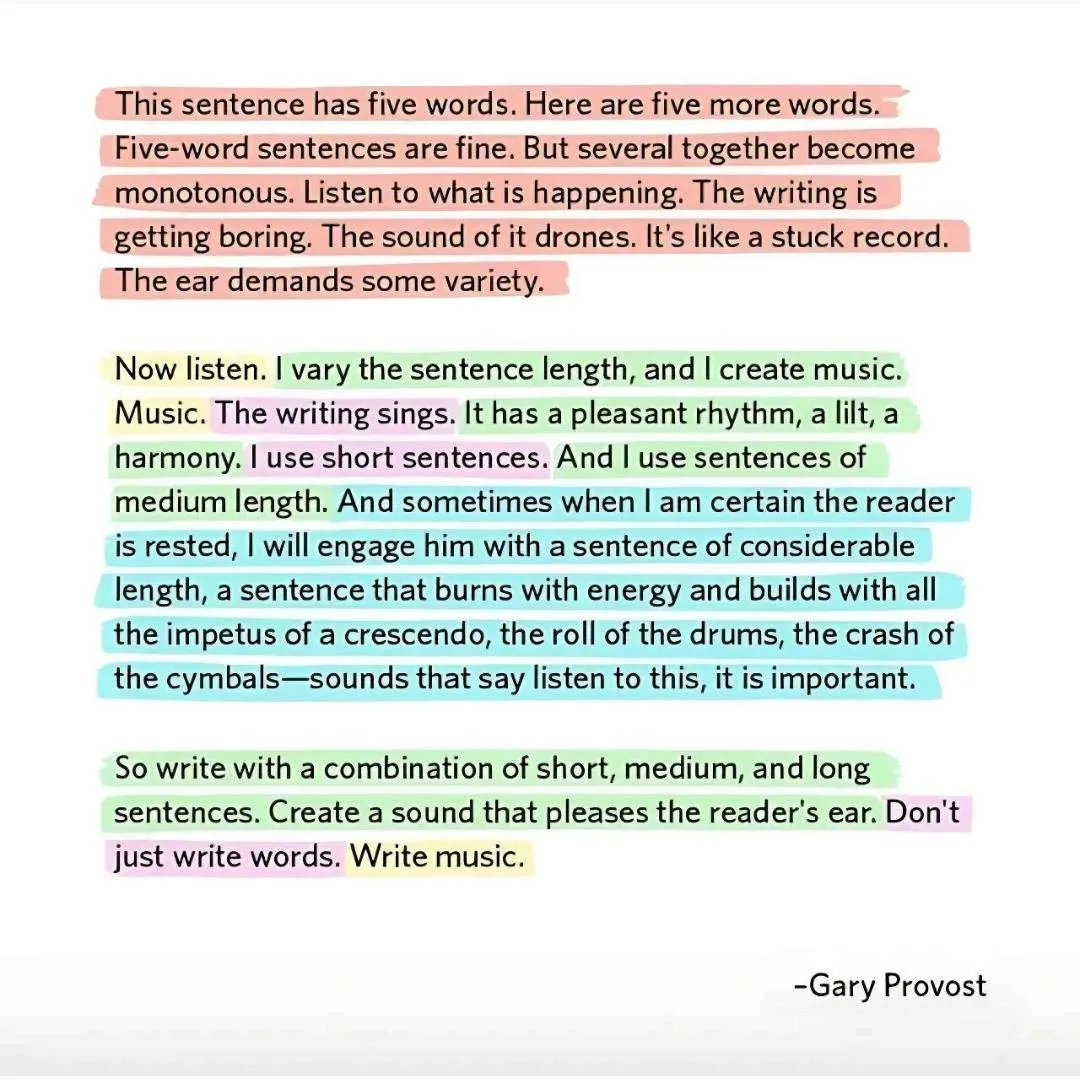
- Vary sentence length and use different structures to convey the message
- “Don’t just write words. Write music.” — Gary Provost
- Finish strong
- Saying no is the ultimate productivity hack. → The ultimate productivity hack is saying no.
- He died on Tuesday. → On Tuesday, he died.
- The easiest path to success is to change the first hour of your morning. → The first hour of your morning determines the height of your success.
- Like a poem (“poetric”)
- “Always write (and read) with the ear, not the eye. You should hear every sentence you write as if it was being read aloud or spoken. If it does not sound nice, try again.” — C. S. Lewis, Advice to a Young Writer
- “Don’t just write words. Write music.” — Gary Provost
- Remove first-party “I” (無機感): 說教式的教科書 → 平易近人地說故事/分享經驗
- Avoid using adverbs. Use strong verbs.
- Adverbs are a sign that you’ve used the wrong verb → e.g., really like → love
- Adverbs often undermine your point
- 多用動詞、名詞,少用形容詞、副詞
- Avoid using passive voice. Use active voice.
- The Zombie Test, a great way to know if you are writing in passive voice
- If you can add “by zombies” to the sentence, it’s passive.
- If you cannot add “by zombies” to the sentence, it’s active.
- The Zombie Test, a great way to know if you are writing in passive voice
- Minimize use of articles (a, an, the) as they in most cases add noise
- Format text to focus attention → Bold = strong emphasis. Italic = soft emphasis.
- Block Quotes
- Only use block quotes for direct quotes. If you are summarizing or paraphrasing someone else’s work, you should not use a block quote.
- Use block quotes sparingly. Too many block quotes can make your notes look cluttered and difficult to read.
- Drop Exclamation Marks: If you want to use an exclamation mark while writing, it means your words aren’t strong enough on their own. Strengthen your sentences instead of compensating with a mark.
- Write the content first, decide the title later (as the last step).
- 標題決定打開率,內文決定轉發率
- Study the art of writing a great/effective HEADLINES by reading MAGAZINES
- Good hook with average content goes viral. Average hook with good content flops.
- People don’t have short attention spans—they finish three-hour Joe Rogan episodes and binge 14-hour shows. What they have are short consideration spans: they need to be hooked immediately. Don’t fear creating deep, in-depth content, but make sure your first minute is incredible/unforgettable.
- 6 ways
- Open with 1 strong, declarative sentence.
- Open with a punchy, thought-provoking, and paradoxical question.
- Open with a controversial opinion.
- Open with a moment in time.
- Open with a vulnerable statement.
- Open with a weird, unique insight.
- 5 elements
- Be clear, not clever
- Specify the WHO
- Specify the WHAT
- Specify the WHY
- Twist The Knife
-
You have to like what you’re writing.
“If you are not enjoying your writing, you’re doing it wrong. A book is not a battle, nor is it a conquest. A book is a story, and telling it should be an enjoyable exercise. So the next time you don’t want to write, don’t waste time beating yourself up. Instead, stop and ask yourself why. Why do you not want to do this fundamentally enjoyable thing? What’s really going on?” — Rachel Aaron, 2,000 to 10,000: How to Write Faster, Write Better, and Write More of What You Love
“Now, instead of treating bad writing days as random, unavoidable disasters to be weathered, like thunderstorms, I started treating them as red flags.” — Rachel Aaron, 2,000 to 10,000: How to Write Faster, Write Better, and Write More of What You Love
- Separate creation and release. When you’ve finished a work, wait a while before you release it to the world.
- Multiple Rewrites: “Round 2 Writing” - 好文章是改出來的,沒有一篇好文章的「初稿」就是「終稿」
- Read it loud
- Focus on one single idea as the lead magnet — the smallest/minimum viable idea you can write about — good writing orbits around a single point so as to create constraints/boundaries
- 1 idea on 1 page using 100–300 words: say more with fewer words
- Fits into a screenshot
- Write small. Write more. → Blogchain (Blog Series) (Blogroll) 8 9
- The Classic 1/3/1 Writing Rhythm
- Beginning: Open with 1 clear sentence
- Middle: Build the point over the next 4 sentences
- End: Close the point with 1 conclusion sentence
- Types
- Experience: “This thing happened to me.”
- Opinion: “Here’s a strongly stated thing.”
- Event: “This thing happened.”
- Barbell Strategy: < 500 or > 2000 words, nothing in between!
- Add “call-to-action” buttons (Share to Twitter!) in the very end
Format/Write the content
Use a subtitle
Place reading time in the subtitle
Add a cover photo (no descriptions, only the reference)
Start with a powerful quote from famous people
Horizontal divider between sections
Put photos sparingly (1 photo for 5 mins)
Ask relatable questions every 1-2 minutes of reading time: (1) on separate lines (2) in italic
Each section = 3-5 paragraphs; Each paragraph = 2-4 lines
Use one-line sentences for emotion-grabbing sentences
Use bold for highlights
Use quotation marks for the main point
Be conversational (having a dialogue, not a monologue)
Actionable or inspiring conclusion drive reader engagement (Call To Action)
Recall headline in the conclusion
Deliberate Publish: “Write with a book in mind.”
Take time to develop your distinct voice (writing style)
Daily Motivation: Micro habits (Health), Quotes, Psychology Theory (storytelling)
Write fast, write bad, and write wrong.
If your writing doesn’t make you feel naked, it’s probably not personal/emotional enough
Expression is compression
You don’t need to have all the answers if you know how to take readers on a journey
Share your writing sooner rather than later. Share half-baked ideas. Feedback-driven writing > Data-driven writing.
“It was really reading the kind of common knowledge and just presenting it in a new way”
If you insist on being original, aim to create an original premise (假定/設; 前提) instead of using only original ideas.
SLOW Writing: Syllabus, Listen, Observe, Write
FAST Writing: Find, Assemble, Speak, Teach
Dissect & Reconstruct
- Find a passage you would like to study. For each sentence, write down notes on the content.
- Rewrite the passage from memory using only your notes on each sentence. This forces you to think.
- Reread the original passage and correct any mistakes. This teaches you sentence construction.
- Take the passage and convert it into poetry. This helps you practice rhythm and flow.
- Convert your poem back to prose. This reinforces your understanding of the passage.
- Jumble your notes on each sentence, then reassemble them in the right order. This teaches you structure and organization of ideas.
- Repeat as many times as you want!
-
Do “public writing” as part of my first pass on the (evergreen) notes.→ Write notes for yourself by default, disregarding audience. You are the audience of one. -
One of the biggest mistakes beginner writers make is thinking they have to be an “expert” to write about something. But this is wrong. The truth is, people don’t want to learn from experts. They prefer to learn from those just a few steps ahead of them on the same path. You don’t need to be an expert or have all the answers to share your work. Beginners can easily help other beginners. Make people better at something they want to be better at. All you have to do is show your work. Think of your work as a never-ending process. You can share your journey in a way that helps/benefits others, rather than the finished product.
- 最好的讀者,是兩年前的自己:人們更願意向那些在同一條路上領先他們幾步的人學習,而不是向專家學習。
- Tutor (助教) vs Professor (教授)
- 最好的讀者,是兩年前的自己:人們更願意向那些在同一條路上領先他們幾步的人學習,而不是向專家學習。
-
Another common mistake that beginner writers make is thinking they can only write “unique” ideas. But the truth is that no one ever had an original idea. Originality is myth/overrated. 10 11 Originality just means hiding your sources. Creativity is just connecting things. New things are usually a combination of existing things. 12 Everything we come up with is a recombination or a remix of (past) things that came before. All creativity stands on the shoulders of giants. True originality consists not in a new manner, but in a new vision. 13 — Seek truth, not originality. If you have an idea but think “someone has already done that,” just remember there are 1,010 published biographies of Winston Churchill. It doesn’t matter if it’s already written before, because it hasn’t been written by you. Do it in your own way. Steal like an artist. 14 Just cite the sources. 15
你寫的最重要的文章,是某人閱讀的第二篇文章。
The most important article you write is the second article someone reads.
- 蒐集資料、素材、靈感(人機各半)
- ⭐️ 寫草稿(人味淨土)
- 編修(用爆 AI)
- 完稿(用爆 AI)
- https://dilbertblog.typepad.com/the_dilbert_blog/2007/06/the_day_you_bec.html
- https://stevenpressfield.com/2009/10/writing-wednesdays-2-the-most-important-writing-lession-i-ever-learned/
-
經過時間沉澱的東西,回頭看總是特別有意思。 ⌃
-
Usefulness > Truthfulness (Pragmatism 實用主義) ⌃
-
A truism (自明之理;陳腔濫調;老生常談;不言而喻的話;老掉牙的說法) is a statement that is so obviously true and doesn’t offer new or meaningful insight. It often sounds wise or profound but simply states what everyone already knows—like saying “If you don’t sleep, you’ll get tired.” or “Everyone dies eventually.” Truisms are commonly used in everyday language, speeches, or writing to appear thoughtful, but they tend to lack depth or usefulness because they state the obvious. ⌃ ⌃2
-
This quote highlights a fundamental truth about writing: brevity requires effort. At first glance, it may seem counterintuitive—how can writing something short take more time than writing something long? But in reality, distilling thoughts into a concise and impactful form demands deep thinking, careful revision, and a sharp focus on clarity. ⌃
-
“Kill your darlings, kill your darlings, even when it breaks your egocentric little scribbler’s heart, kill your darlings.” — Stephen King ⌃
-
「盡信書,則不如無書」—《孟子》第十四卷盡心篇下 ⌃
-
Or simple use tags ⌃
-
When creating art, books, stories—anything—don’t let the pursuit of originality freeze you. There’s something much more important than originality anyway: resonance. And resonance is something you can repeatedly accomplish. Resonance is expressing an idea so cleanly and truthfully, in a way that speaks to today’s sensibilities, that people can’t help but absorb it. It’s familiar yet relatable storytelling that reveals a simple truth and, for a moment, takes over the reader’s mind. Retelling an age-old story with more truth and better narrative is more powerful than originality: after all, you’ll rarely change someone’s life by telling them something new, but you can reliably affect them by saying something so well that it compels them to lean in. ⌃
-
I find it valuable to build ideas from my own notes and journals — a bottom-up approach inspired by the Zettelkasten Method. This process turns writing into an act of synthesis rather than imitation. By drawing connections among diverse materials, my work naturally becomes a kind of authentic pastiche/hodgepodge — a creative mosaic shaped by multiple influences and unified by my own perspective. In this way, originality emerges from the thoughtful recombination of what I’ve learned, observed, and experienced. ⌃
-
For example, Jazz is a vibrant blend of European instruments and African rhythms, characterized by syncopation, improvisation, and a unique musical dialogue that bridges diverse cultural traditions. ⌃
-
by Edith Wharton ⌃
-
畢卡索曾說:「好的藝術家懂得模仿,偉大的藝術家善於偷取/渡。(“Good artists copy, great artists steal.”)」因此,竊取偉大的點子沒有什麼好羞恥的。 ⌃
-
Plagiarism happens when you copy and paste somebody else’s ideas without attribution. That’s not okay. You can avoid it by following two rules: (1) if you use an author’s ideas verbatim, give the original author credit, and (2) when in doubt, acknowledge the source of your ideas. ⌃
