
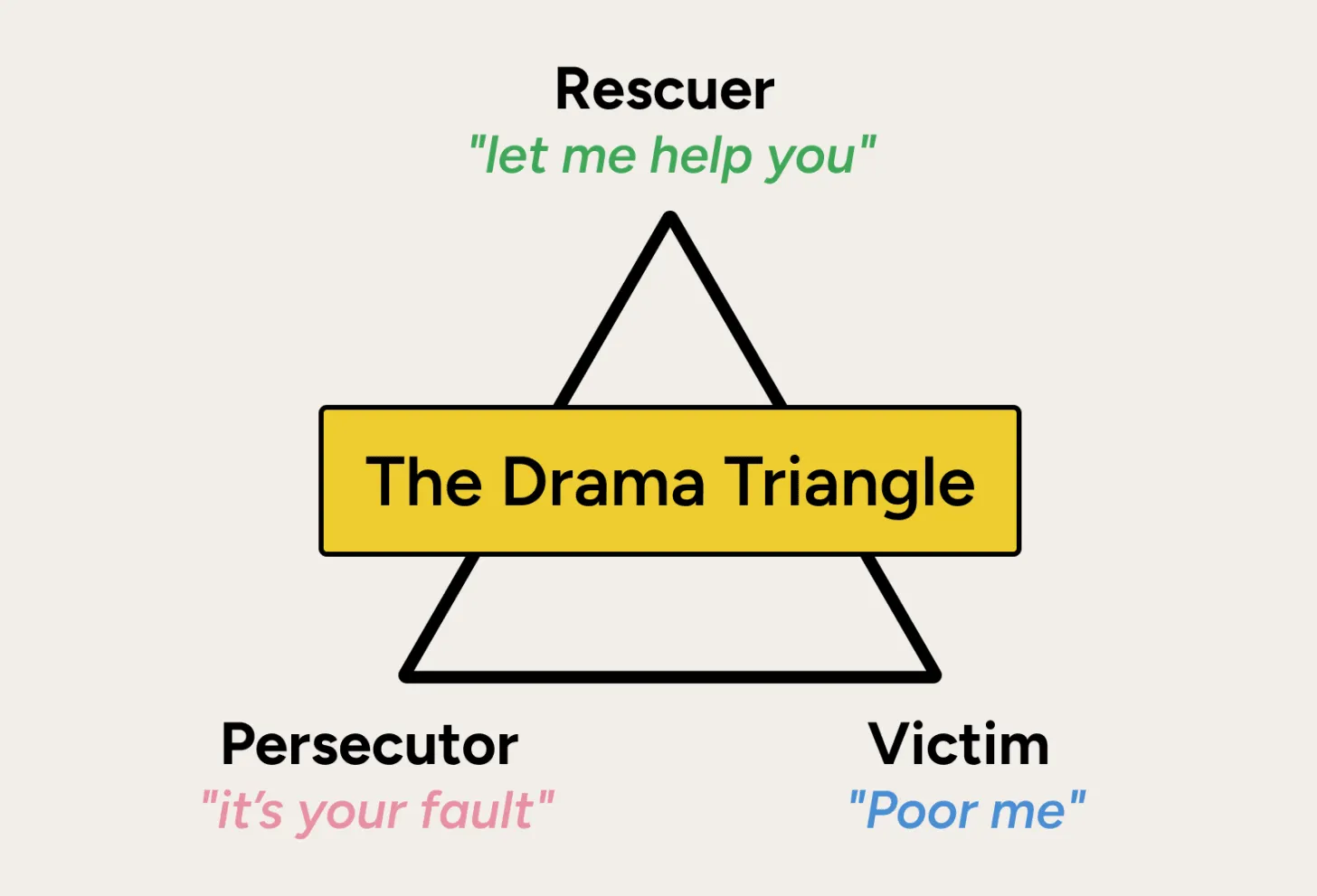
In 1968, psychiatrist Stephen Karpman introduced the “Drama Triangle” model, which describes three roles people unconsciously cycle through:
- The Victim (“poor me”)
- The Persecutor (“it’s your fault”)
- The Rescuer (“let me help you”)
These roles are fluid and often shift. A Rescuer who feels unappreciated may become a Persecutor. A Victim who builds up enough resentment can also turn into a Persecutor. Regardless of where you start, everyone eventually feels like a victim.
 |
|---|
| Source |
In organizations, this dynamic manifests as triangulation: Person A has an issue with Person B but goes to a manager instead of speaking directly to B. The manager then inherits anxiety that belongs to A and B.
David Emerald’s Empowerment Dynamic offers a practical antidote: communicate directly.
In this model:
- The Victim transforms into a Creator who asks, “What do I want?”
- The Persecutor becomes a Challenger who holds others accountable with care.
- The Rescuer shifts to a Coach who asks, “Have you spoken to them about this?”
