
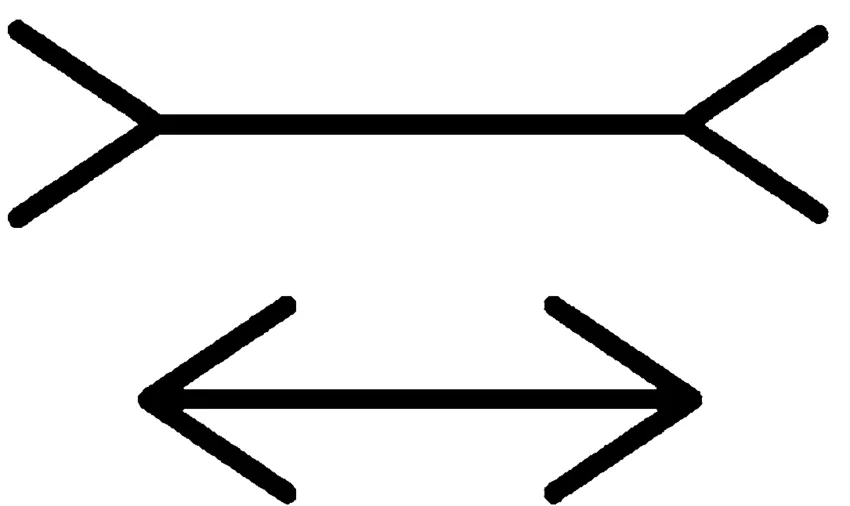
The Mueller-Lyer illusion is a classic example in cognitive psychology that demonstrates the persistent gap between perception (System 1) and rational understanding (System 2).
In the illusion, two lines of equal length appear different because of the orientation of arrow-like fins at their ends. Even after measuring the lines and knowing they are equal, the visual system continues to insist that one is longer than the other.
This phenomenon illustrates the power and limitations of System 1, the fast, automatic, and intuitive part of our mind. System 1 is responsible for quick judgments and snap decisions. System 2, on the other hand, is slower, more deliberate, and logical. It can override System 1’s errors, but only with conscious effort—and even then, the intuitive impression often lingers.
Imagine looking at the Mueller-Lyer illusion for the first time. Your immediate, automatic response (System 1) is to say that the bottom line is longer than the top line. If someone hands you a ruler and you measure them, your logical mind (System 2) recognizes the truth: the lines are of equal length. Yet, despite this knowledge, your perception does not change. System 1 sticks to the illusion and continues to “see” that the bottom line is longer. This demonstrates how some cognitive illusions are resistant to correction, even in the face of clear evidence.
